Imagine the scenario: you’ve signed the contract, agreed on the price, written “FOB Shanghai” on the invoice, and shipped the goods for export. Everything seems fine. But when the cargo reaches its destination, a dispute arises:
• Who was responsible at the moment the cargo was picked up from the supplier’s warehouse?
• Who pays for incomplete export documentation?
• And most importantly, who covers the damage for the three pallets that were compromised somewhere between the warehouse and the aircraft?
The answer isn’t found anywhere in the contract. This is mainly because FOB does not clearly define these responsibilities in the context of air freight.
Why Do We Still Use FOB for Air Freight?
OB – Free On Board – is probably the most widely recognized lncoterm in the world. lt appears in banking forms, legacy contracts, and templates inherited from procurement departments that have worked the same way for decades. Many logistics managers still use it out of ha bit: “We’ve always used FOB – it works.”
But that assumption is flawed.
FOB was designed for non-containerized cargo loaded onto a vessel, where there is a clear physical point at which risk transfers from seller to buyer: when the goods pass the ship’s rail.
ln air freight, that moment simply does not exist. There is no vessel, no “on board” equivalent, and no physical reference point where responsibility clearly shifts.
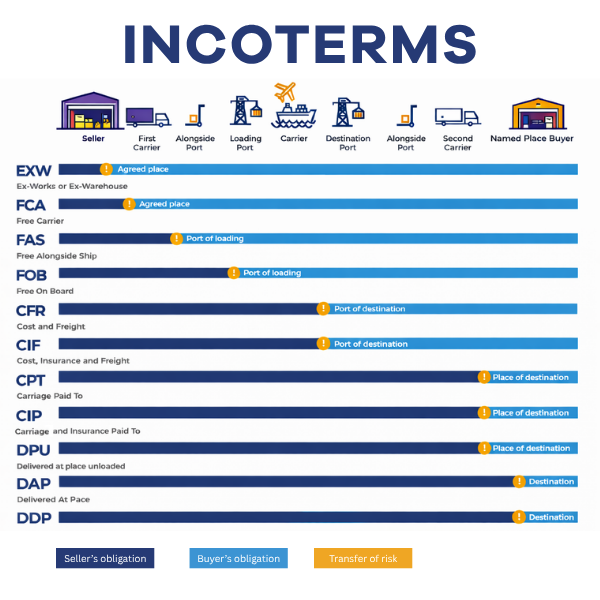
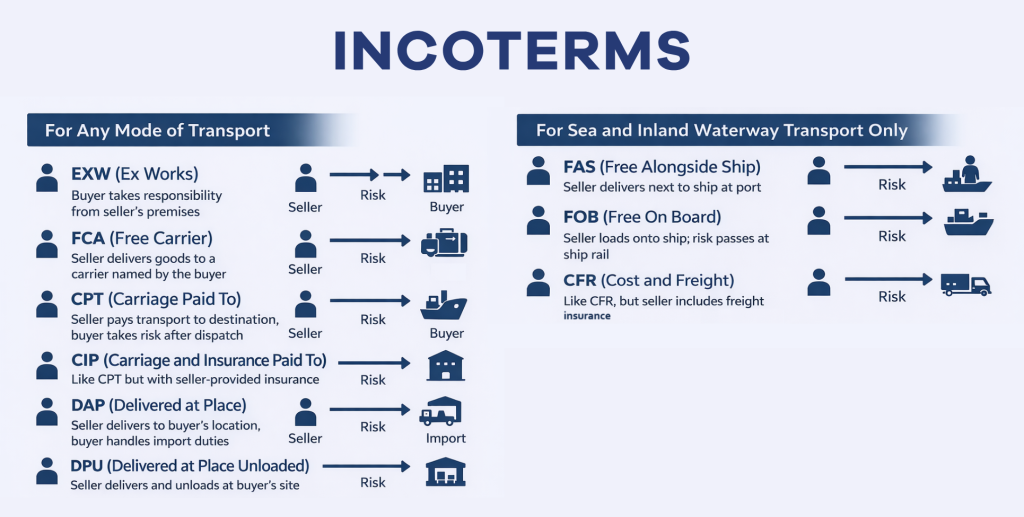
Under lncoterms® 2020, FOB – along with CIF, CFR, and FAS – is explicitly classified under “Sea and lnland Waterway Transport Only.” These rules are not intended for use in containerized, multimodal, road, rail, or air transport.
What Happens in Practice When You Use FOB for Air Freight?
The problem doesn’t show up in every shipment.
lt shows up when something goes wrong-and that’s when ambiguity becomes expensive.
Scenariul 1: Cargo Damaged Between Terminal and Aircraft
Scenario 2: Customs Declaration Discrepancy
Scenario 3: Cargo Not Covered by lnsurance
The Solution: FCA-The lncoterm Designed for This Exact Situation
FCA (Free Carrier) is not a workaround. lt is the lncoterm specifically created for situations where goods are handed over to a carrier at a terminal, warehouse, or airport – before actual loading onto the main mode of transport.
How FCA Works for Air Freight
- The seller delivers the goods to the agreed location – for example, the airport cargo terminal of departure
- The seller completes export customs clearance
- From that moment, risk and costs are transferred to the buyer
- The buyer {or their freight forwarder) takes over: books the flight, manages transport documents, and arranges delivery at the destination
Key Advantage of FCA: Precision
FCA removes ambiguity by defining an exact handover point, such as
- FCA Henri Coandă Airport, Bucharest
- FCA Frankfurt Airport Cargo Terminal
FOB vs. FCA for Air Freight — Direct Comparison
| Criterion | FOB (Free on Board) | FCA (Free Carrier) |
|---|---|---|
| Applicable to air freight? | No (per International Chamber of Commerce Incoterms® 2020) | Yes — specifically designed for this |
| Clear point of risk transfer | Ambiguous | At handover to the carrier |
| Export customs – who handles it? | Seller | Seller |
| Flight booking/freight arrangement | Buyer | Buyer |
| Recommended by ICC for air transport | No | |
| Compatible with letters of credit | Frequently misused | Yes, with bank alignment |
“But My Bank Requires FOB on the Letter of Credit … “
This is the most common objection. Many banking forms still list FOB as a default option because they were originally designed around maritime transport and have not been updated.
The solution is not to comply with an incorrect term – it’s to educate the bank.
The lnternational Chamber of Commerce provides clear guidance on why FCA is the correct lncoterm for air freight and why FOB creates ambiguity in these contexts. An experienced freight forwarder can support this discussion and help amend the letter of credit terms accordingly.
What You Should Do in Practice
- Audit your current contracts: wherever FOB appears in air or multimodal shipments, replace it with F.CA
- Always specify the exact location: not just FCA Bucharest, but FCA Henri Coandă Airport, Bucharest – vagueness creates cost
- Align insurance with the actual risk transfer point: coverage should start exactly where the seller’s responsibility ends.
- Complete documents correctly: if you use letters of credit, ensure the correct lncoterm is referenced
- Work with an experienced freight forwarder: in practice, a forwarder specialized in international air freight handles FCA, EXW, or DDP shipments daily and can guide you toward the right choice for your specific case
Are you managing ongoing contracts or preparing to negotiate new delivery terms?
Note: lncoterms® is a registered trademark of the lnternational Chamber of Commerce. This content provides general information and does not constitute legal advice.
OEPIA – Fresh transport and logistics solutions. Your cargo is our priority.