Skip to Content

    Category Archives: Events

    Air Freight lncoterms (DDP, FCA, EXW): How to Choosethe Right Terms & Avoid Mistakes

    lncoterms® (lnternational Commercial Terms) are globally recognized rules that define the responsibilities of buyers and sellers in international trade. They determine who pays for transport, insurance, and duties, and when the risk of the goods transfers from the seller to the buyer. ln air freight, choosing an lncoterm is not just a contractual formality, but alsa an operational decision that directly affects costs, risks, and your relationship with trading partners. Here’s what should guide your choice and the mistakes you must avoid.
    Four Key Factors to Consider When Choosing an lncoterm

    1. Logistics Expertise and lnfrastructure

    Buyers with strong logistics operations and strong relationships with freight forwarders often prefer FCA or EXW to maximize control and cost optimization. Buyers without import experience usually prefer DDP, where the seller manages the complexity.


    Sellers with established logistics capabilities and a local presence in the destination country can offer DDP as a competitive differentiator, while those without such infrastructure often choose FCA, leaving the local complexity up to the buyer.

    2. Cash Flow and VAT lmplications

    DDP requires the seller to pay import VAT upfront, potentially locking funds until the invoice is collected and making recovery more complex. FCA and EXW transfer customs duties and VAT to the buyer, who, as the local im porter, can reclaim them taster and more efficiently.

    3. Desired Levei of Control and Service

    Buyers who want to control carriers, routes, and delivery timing prefer FCA or EXW. Sellers who want to guarantee high-quality service throughout the delivery cycle prefer DDP. The party controlling logistics optimizes for its own priorities – buyers for cost, sellers for customer experience.

    4. lndustry Standards and Market Expectations

    Some industries use default lncoterms, and a deviation from this can create friction even if it is operationally justified. Retail buyers often expect DDP, treating international suppliers like local vendors. Industrial buyers frequently prefer FCA, managing all shipments through their own logistics providers.

    lncoterms as a Strategic Business Tool, Not Just Operational Rules

    Beyond operational necessity, choosing the right lncoterm can be a strategic business tool.


    Sellers offering DDP differentiate themselves in markets where competitors provide FCA or EXW, simplifying the purchase decision for clients with limited import experience. The all-inclusive price can justify premiums that exceed the seller’s logistics and customs costs. For Romanian companies exporting to Western European markets, where buyers expect tuli delivery, offering DDP can serve as an effective market entry strategy.


    Conversely, buyers negotiating EXW can achieve real cost savings when their logistics capabilities exceed those of their suppliers. Large buyers consolidating volumes from multiple suppliers can negotiate air freight rates that individual suppliers could not secure, making buyer-controlled logistics under EXW more cost-effective than seller-arranged terms.


    At OEPIA, we work with clients to recommend lncoterms aligned with their business model, operational capabilities, and strategic objectives – from export support for FCA shipments from Romania to import customs handling for DDP deliveries to Roman ia.

    Common Mistakes and Howto Avoid Them

    1. Using FOB for air freight – still the most widespread error, often due to banking requirements, contract templates, or inertia. Solution: Replace FOB with FCA in all air freight contracts. lf banks resist, provide ICC references explaining why FCA is correct.
    2. Vague destination descriptions – e.g., “DDP Milan” could mean the airport, buyer’s warehouse, or an intermediate point. Solution: Specify precisely: “DDP Via Dante 27, Milan” or “DDP Milan Malpensa Airport” to eliminate ambiguity regarding risk and cost transfer.
    3. Confusing lncoterms with payment terms – lncoterms allocate costs, risks, and logistics responsibilities,s but do not specify payment timing. Payment terms must be negotiated and documented separately.
    4. lnsurance not aligned with risk transfer – Coverage must start exactly when the risk passes under the chosen lncoterm. Too early = double payment; too late = no coverage for part of the journey.
    5. lgnoring country-specific customs rules – India calculates duties on CIF value; South Africa on FOB value. The chosen lncoterm directly affects the duties paid at the destination. Research local import requirements before committing to DDP or other terms requiring local capabilities.

    Common Mistakes and Howto Avoid Them


    Practicai experience in coordinating air freight under various lncoterms shows that success requires more than understanding contractual responsibilities – it demands systems, processes, and partnerships that turn the terms into smooth logistics operations.


    Timing coordination is criticai: cargo must arrive at the airport within the acceptance window, which can be only a few hours before departure. A documentation error can mean a missed flight, storage fees, and supply chain delays. Communication between parties must be clear and timely so the buyer’s freight forwarder can coordinate effectively with the seller’s logistics operations.


    Customs documentation must reflect the chosen lncoterm, as it influences not only the logistics arrangements but also the actual duties and taxes paid at the destination. As regulations such as ICS2, EUDR, and country-specific import requirements multiply, the ability to manage documentation correctly under any lncoterm becomes a differentiating capability – not all freight forwarders have it to the same degree.

    Stil 1

    lncoterms 2020 represents the current version of ICC rules. Updating commercial contracts and internai templates to reflect this version is a straightforward step that prevents costly ambiguities.

    Concrete Steps for Businesses

    Choosing the correct lncoterm is the first step. Executing it correctly – with precise documentation, coordinated acceptance windows, aligned insurance, and smooth customs clearance – is what turns a contract into cargo delivered on time.


    Whether you need export support for FCA shipments from Romania to European destinations, import customs handling for DDP deliveries to Roman ia, or EXW support for full supply chain management our team at OEPIA helps clients select lncoterms aligned with their business model, operational capabilities, and strategic objectives – from FCA export support from Romania to DDP import customs handling in Romania. OEPIA’s international air freight expertise makes the difference between smooth transport and logistica! headaches.

    Stil_3

    Need Air Freight Services?

    OEPIA specialists guide you from selecting the right lncoterm to full execution of international air freight.
    👉 Contact an OEPIA expert: air.sea@oepia.ro

    Note: lncoterms® is a registered trademark of the lnternational Chamber of Commerce. This article provides general information and does not constitute legal advice.

    OEPIA — Fresh transport and logistics solutions. Your cargo is our priority.
    3 Continue Reading →

    lncoterms in Air Freight: How EXW, FOB, and DDP Affect Operational Reality

    You’ve signed the contract, agreed on the price, specified an lncoterm, and you think everything is clear. Until the first dispute arises: who pays for incomplete export documents? Who covers damaged cargo at the terminal? Who handles customs clearance at the destination?


    lncoterms are three letters that answer all these questions, but only if they are chosen correctly. Here’s what EXW, FOB, and DDP mean in the reality of international air freight.

    What lncoterms Are and Why They Matter

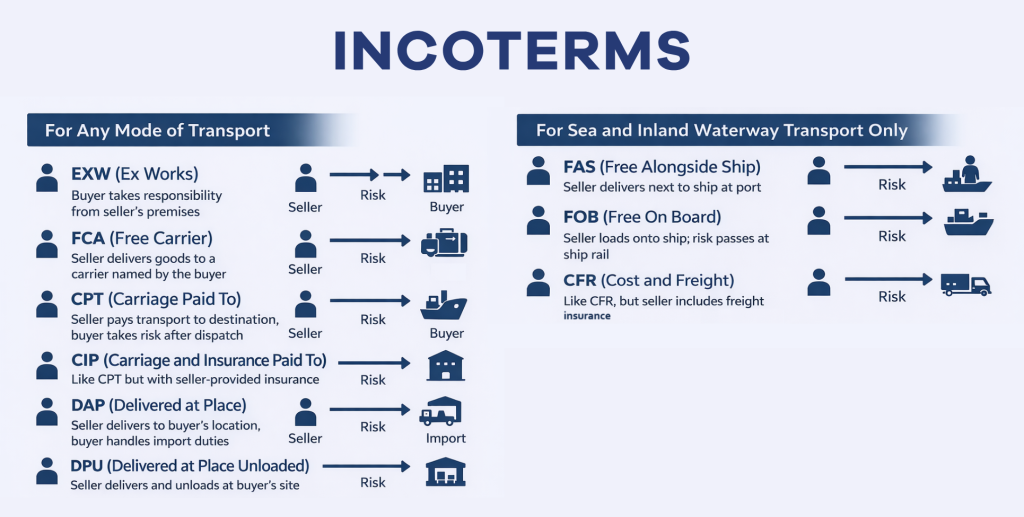
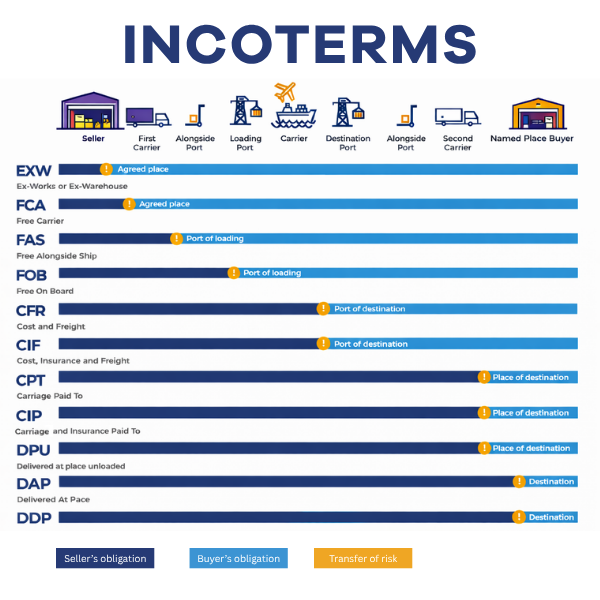
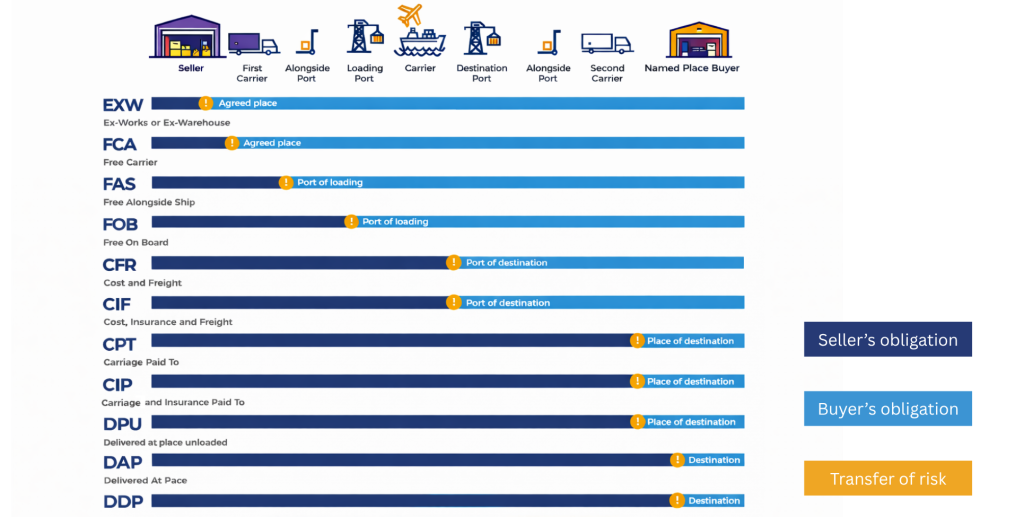
    lncoterms (lnternational Commercial Terms) are 11 standardized rules created by the lnternational Chamber of Commerce (ICC), most recently updated in 2020. They define who bears the costs, who assumes the risk, and who manages customs formalities at each stage of an international shipment.


    They appear on invoices, contracts, letters of credit, and insurance policies. A price without a specified lncoterm is an incomplete price, because it is unclear what is included.

    Two Categories. An Essential Distinction.

    lncoterms 2020 are divided into two groups:


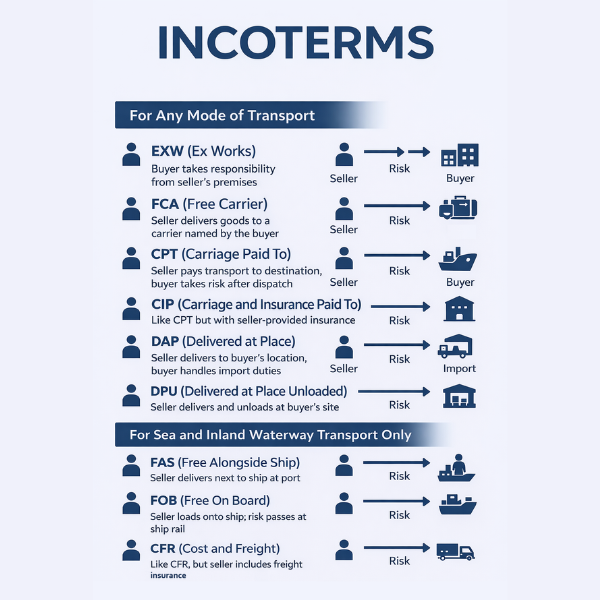
    For any mode of transport: EXW, FCA, CPT, CIP, DAP, DPU, DDP
    Exclusively for maritime and inland waterway transport: FOB, FAS, CFR, CIF


    This distinction is frequently ignored in practice, and it is precisely here that the most costly errors in international air freight occur.

    EXW – Maximum Control for the Buyer

    Under EXW {Ex Works), the seller simply makes the goods available at their premises. That’s it. Everything that follows – domestic transport to the airport, export customs, flight booking, import customs clearance, final delivery – falls under the buyer’s responsibility.


    Advantage: the buyer controls the entire logistics chain, can consolidate shipments from multiple suppliers, and negotiates directly with their freight forwarder.

    Caution: export customs becomes the buyer’s responsibility, even though the buyer is not established in the seller’s country. Many customs authorities refuse or complicate declarations submitted by foreign buyers, which can cause delays and additional costs that offset the initial advantages.

    EXW works well when the buyer has a reliable freight forwarder in the supplier’s country. Otherwise, it becomes more complicated than it initially appears.

    FOB – The Most Commonly Misused Term in Air Freight

    FOB (Free On Board) is probably the mast well-known lncoterm in the world – and the mast incorrectly applied in the air freight context.


    FOB was designed for non-containerized goods loaded anto a ship. Risk passes from the seller to the buyer the moment the goods cross the ship’s rail. ln air freight, that moment does not exist – there is no ship, and there is no rail.


    lncoterms 2020 explicitly classify FOB as maritime transport only. The ICC clearly recommends: for air freight, use FCA instead of FOB.


    Yet FOB continues to appear in air freight contracts – out of inertia, because of old banking templates, or simply because it has always been used. Problems arise when something goes wrong: the moment of risk transfer becomes ambiguous, customs declarations may not match, and cargo may be uninsured between the terminal and the aircraft.


    Solution: replace FOB with FCA (Free Carrier). FCA works exactly as you would expect FOB to work in practice – the seller delivers the goods to the cargo terminal, completes export formalities, and risk passes clearly to the buyer at that precise moment.


    Correct example: FCA Henri Coandă Airport, Bucharest.

    DDP — Easiest for the Buyer, Most Complex for the Seller

    Under DDP (Delivered Duty Paid), the seller delivers the goods to the destination with absolutely everything included: air transport, unloading, import customs clearance, customs duties, VAT, and final delivery. The buyer does nothing except receive the goods.

    Advantage for the buyer: a fixed price, no surprises. Treat an international supplier as if they were local.

    Challenges for the seller: DDP mea ns the seller pays import VAT in the destination country – VAT that the buyer could recover if they were the legal importer. For a shipment of €100,000 with 21% VAT, the seller advances €21,000. On top of that, air freight rates fluctuate weekly – a firm long-term DDP quote is difficult to maintain without safety margins.

    DDP is a powerful commercial tool for sellers who want to simplify the buyer’s purchase decision, but it requires clear customs capabilities in the destination country and careful cost management.

    How to Choose? Three Practicai Questions

    1. Who has more logistics experience and better relationships with carriers, you or your commercial partner? The party with greater capability should control the transport.

    2. Who can more easily handle import VAT? Under DDP, the seller advances it; under FCA or EXW, the buyer pays and can recover it more quickly as the established im porter.

    3. What level of visibility and control do you need? The more control you assume, the more responsibility you carry. There is no perfect lncoterm, only the right one for your situation.

    What This Means in Practice

    Companies working with experienced freight forwarders in international air freight use lncoterms as a strategic tool, not just a formality. Choosing correctly ensures predictable costs, clear responsibilities, and zero surprises at customs.


    Regardless of whether you ship under EXW, FCA, or DDP, proper execution requires precise coordination: error-free documentation, compliance with acceptance windows, and insurance aligned with the actual moment of risk transfer.

    Stil_3

    Do you want to optimize your lncoterm selection process for air shipments?

    OEPIA specialists work daily with exporters and importers who need operational clarity and competitive services.
    👉 Talk to an OEPIA specialist – air.sea@oepia.ro

    Note: lncoterms® is a registered trademark of the lnternational Chamber of Commerce. This article provides general information and does not constitute legal advice.

    OEPIA — Fresh transport and logistics solutions. Your cargo is our priority.
    3 Continue Reading →

    Using FOB for Air Freight? Here’s Why lt’s Wrong andYour Better Options


    Imagine the scenario: you’ve signed the contract, agreed on the price, written “FOB Shanghai” on the invoice, and shipped the goods for export. Everything seems fine. But when the cargo reaches its destination, a dispute arises:

    • Who was responsible at the moment the cargo was picked up from the supplier’s warehouse?
    • Who pays for incomplete export documentation?
    • And most importantly, who covers the damage for the three pallets that were compromised somewhere between the warehouse and the aircraft?

    The answer isn’t found anywhere in the contract. This is mainly because FOB does not clearly define these responsibilities in the context of air freight.

    Stil 1
    ln fact, FOB should never have been included in an air freight contract.
    According to lncoterms® 2020 by the lnternational Chamber of Commerce, FOB is a term strictly applicable to sea and inland waterway transport only.

    Why Do We Still Use FOB for Air Freight?

    OB – Free On Board – is probably the most widely recognized lncoterm in the world. lt appears in banking forms, legacy contracts, and templates inherited from procurement departments that have worked the same way for decades. Many logistics managers still use it out of ha bit: “We’ve always used FOB – it works.”
    But that assumption is flawed.
    FOB was designed for non-containerized cargo loaded onto a vessel, where there is a clear physical point at which risk transfers from seller to buyer: when the goods pass the ship’s rail.
    ln air freight, that moment simply does not exist. There is no vessel, no “on board” equivalent, and no physical reference point where responsibility clearly shifts.

    Under lncoterms® 2020, FOB – along with CIF, CFR, and FAS – is explicitly classified under “Sea and lnland Waterway Transport Only.” These rules are not intended for use in containerized, multimodal, road, rail, or air transport.

    What Happens in Practice When You Use FOB for Air Freight?

    The problem doesn’t show up in every shipment.
    lt shows up when something goes wrong-and that’s when ambiguity becomes expensive.

    Stil_2

    Scenariul 1: Cargo Damaged Between Terminal and Aircraft

    The supplier delivers the goods to the airport cargo terminal. The buyer has booked the flight. The cargo is damaged somewhere between handover at the terminal and loading onto the aircraft. Who is responsible? FOB does not clearly define the point of risk transfer for air freight, so both parties can argue different interpretations.
    Stil_2

    Scenario 2: Customs Declaration Discrepancy

    The bank requires a letter of credit and asks for an lncoterm. The buyer writes FOB. At the destination, customs authorities calculate duties based on the CIF value {cost + insurance + freight), but the documents reflect a FOB value, excluding freight. The resuit? A declaration discrepancy, fines, and severa I days of delay.
    Stil_2

    Scenario 3: Cargo Not Covered by lnsurance

    lnsurance Damage occurs during transport. The buyer’s insurer claims coverage starts from the moment the goods are handed over to the carrier. The seller’s insurer argues that the risk transferred to the buyer once the goods were delivered to the terminal. This creates a gap – sometimes just a few hours, sometimes longer – during which the cargo is not clearly covered by either party.

    The Solution: FCA-The lncoterm Designed for This Exact Situation

    FCA (Free Carrier) is not a workaround. lt is the lncoterm specifically created for situations where goods are handed over to a carrier at a terminal, warehouse, or airport – before actual loading onto the main mode of transport.

    How FCA Works for Air Freight

    • The seller delivers the goods to the agreed location – for example, the airport cargo terminal of departure
    • The seller completes export customs clearance
    • From that moment, risk and costs are transferred to the buyer
    • The buyer {or their freight forwarder) takes over: books the flight, manages transport documents, and arranges delivery at the destination

    Key Advantage of FCA: Precision
    FCA removes ambiguity by defining an exact handover point, such as

    • FCA Henri Coandă Airport, Bucharest
    • FCA Frankfurt Airport Cargo Terminal
    There is no room for interpretation – risk transfers at a clearly defined, documented location.

    FOB vs. FCA for Air Freight — Direct Comparison

    CriterionFOB (Free on Board)FCA (Free Carrier)
    Applicable to air freight? No (per International Chamber of Commerce Incoterms® 2020) Yes — specifically designed for this
    Clear point of risk transfer Ambiguous At handover to the carrier
    Export customs – who handles it?SellerSeller
    Flight booking/freight arrangementBuyerBuyer
    Recommended by ICC for air transportNo
    Compatible with letters of credit Frequently misused Yes, with bank alignment

    “But My Bank Requires FOB on the Letter of Credit … “

    This is the most common objection. Many banking forms still list FOB as a default option because they were originally designed around maritime transport and have not been updated.

    The solution is not to comply with an incorrect term – it’s to educate the bank.
    The lnternational Chamber of Commerce provides clear guidance on why FCA is the correct lncoterm for air freight and why FOB creates ambiguity in these contexts. An experienced freight forwarder can support this discussion and help amend the letter of credit terms accordingly.

    Stil 1
    Why This Matters
    • A correctly chosen lncoterm protects all parties involved – including the bank.
    • A short-term compromise can turn into a real legal and financial issue in the event of damage or dispute.
    ln practice, using FCA instead of FOB reduces ambiguity, aligns with lncoterms® 2020, and ensures that responsibilities are clearly defined from the outset.

    What You Should Do in Practice

    • Audit your current contracts: wherever FOB appears in air or multimodal shipments, replace it with F.CA
    • Always specify the exact location: not just FCA Bucharest, but FCA Henri Coandă Airport, Bucharest – vagueness creates cost
    • Align insurance with the actual risk transfer point: coverage should start exactly where the seller’s responsibility ends.
    • Complete documents correctly: if you use letters of credit, ensure the correct lncoterm is referenced
    • Work with an experienced freight forwarder: in practice, a forwarder specialized in international air freight handles FCA, EXW, or DDP shipments daily and can guide you toward the right choice for your specific case
    Stil_3

    Are you managing ongoing contracts or preparing to negotiate new delivery terms?

    OEPIA specialists provide practicai insights based on real international air freight operations.
    👉 Speak directly with an OEPIA expert: → air.sea@oepia.ro

    Note: lncoterms® is a registered trademark of the lnternational Chamber of Commerce. This content provides general information and does not constitute legal advice.

    OEPIA – Fresh transport and logistics solutions. Your cargo is our priority.
    3 Continue Reading →